
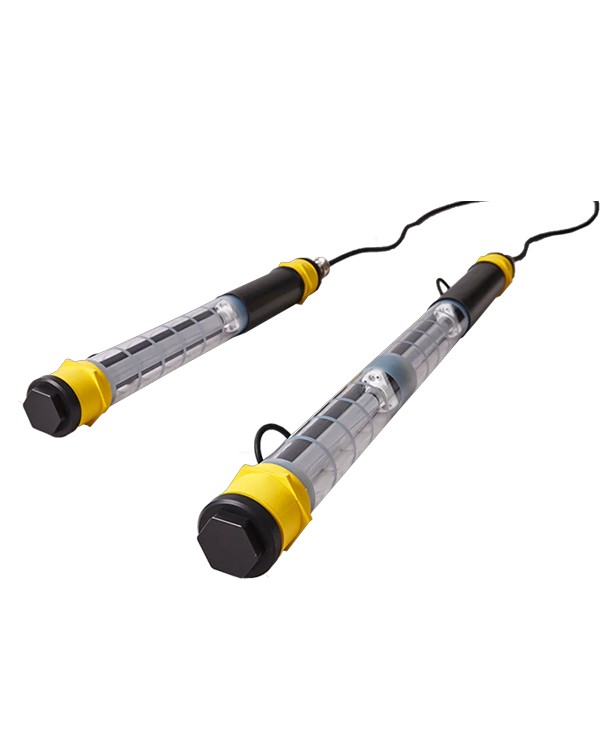
The Wolf TY-300 is an ultra-compact and lightweight next-generation ex-proof inspection lamp, specifically engineered for detailed inspections, technical surveys, and maintenance operations in hazardous areas. Offered by IST Safety Ltd, the official distributor of Wolf, this leadlamp model provides exceptional maneuverability in confined spaces while ensuring maximum visibility.
Certified for Zone 1/21, the TY-300 provides total safety in explosive gas and dust atmospheres. Utilizing advanced LED technology, it delivers bright and uniform illumination. With its impact-resistant polycarbonate lens and ergonomic handle, it remains the most reliable equipment for personnel working under the toughest industrial conditions.
The TY-300 is a small, portable LED inspection lamp designed for use in dangerous areas (ATEX Zone 1/21). It can be held easily for close inspections or hung up with the swivel hooks to provide temporary lighting. Its simple, low-maintenance design makes it ideal for tough environments.
|
PRODUCT REFERENCE |
TY-300 /18/H0FR10/ATX110 |
TY-300 /26/H0FR10/ATX110 |
TY-300 /18/H0FR10/ATX230 |
TY-300 /26/H0FR10/ATX230 |
|
PRODUCT DESCRIPTION |
ATEX LED Portable Inspection Light |
|||
|
CODE |
II 2 G Ex eb mb IIC T4 Gb |
|||
|
CERTIFICATE NUMBERS |
ExVeritas 24ATEX1826X / IECEx EXV 24.0024X / ExVeritas 24 UKEX 1827X |
|||
|
AREA OF CLASSIFICATION (GAS) |
Zones 1 & 2 |
|||
|
TEMPERATURE CLASS (GAS) |
T4 |
|||
|
AREA OF CLASSIFICATION (DUST) |
Zones 21 & 22 |
|||
|
LOWER AMBIENT TEMPERATURE |
-20°C |
|||
|
UPPER AMBIENT TEMPERATURE |
+40°C |
|||
|
MAX. SURFACE TEMPERATURE (DUST) |
T80°C |
|||
|
VOLTAGE RANGE (VAC) |
88-140 |
|||
|
MAX INPUT CURRENT (A) |
0.2 |
0.35 |
0.1 |
0.15 |
|
POWER FACTOR |
>0.85 |
>0.90 |
>0.85 |
>0.90 |
|
LIGHT OUTPUT (LUMENS EMITTED) |
1,005 |
1,390 |
1,005 |
1,390 |
|
INGRESS PROTECTION |
IP66 |
|||
|
ENCLOSURE |
Polycarbonate tube with anodised aluminium end caps |
|||
|
LED TECHNOLOGY |
1 x DLO |
2 x DLO |
1 x DLO |
2 x DLO |
|
WEIGHT (EXCLUDING CABLE) |
1.6 kg |
2.0 kg |
1.6 kg |
2.0 kg |
What is ATEX and what does exproof mean? The ATEX directive is a set of European Union standards that define the safety requirements for equipment used in hazardous areas with explosive atmospheres. Exproof (Explosion-proof) refers to protection methods designed to prevent explosions by inhibiting the formation of sparks or electrical arcs in environments containing flammable gases, dust, or vapors. To ensure life and property safety in industrial facilities, the use of ATEX-certified exproof devices is a legal requirement.
ATEX Zone coding is a technical classification based on the frequency and duration of the occurrence of an explosive atmosphere in a given area. While the terms Zone 0, 1, and 2 are used for risks originating from gas, vapor, and mist; the codes Zone 20, 21, and 22 are designated for environments containing combustible dust. This classification is a legal standard that determines the required Equipment Protection Level (EPL) for devices. Accurate zone identification both optimizes operational costs and minimizes occupational safety risks.
In addition to ATEX certification, some projects may also require the IECEx Certification System (International Electrotechnical Commission Explosive Atmospheres System) certification. IECEx is an internationally recognized conformity assessment system for equipment intended for use in explosive atmospheres.
While ATEX is a European Union directive and a legal requirement within the European market, IECEx is a globally accepted certification system, widely preferred in regions such as the Middle East, Asia, and Australia.
From a technical perspective, both ATEX and IECEx are based on similar standards (e.g., the EN/IEC 60079 series). However:
Therefore, while ATEX certification may be sufficient for certain projects, international tenders or critical industries such as oil & gas often prefer or require products that are certified to both ATEX and IECEx standards.
The appropriate certification should be determined based on the project location, client requirements, and application area.